
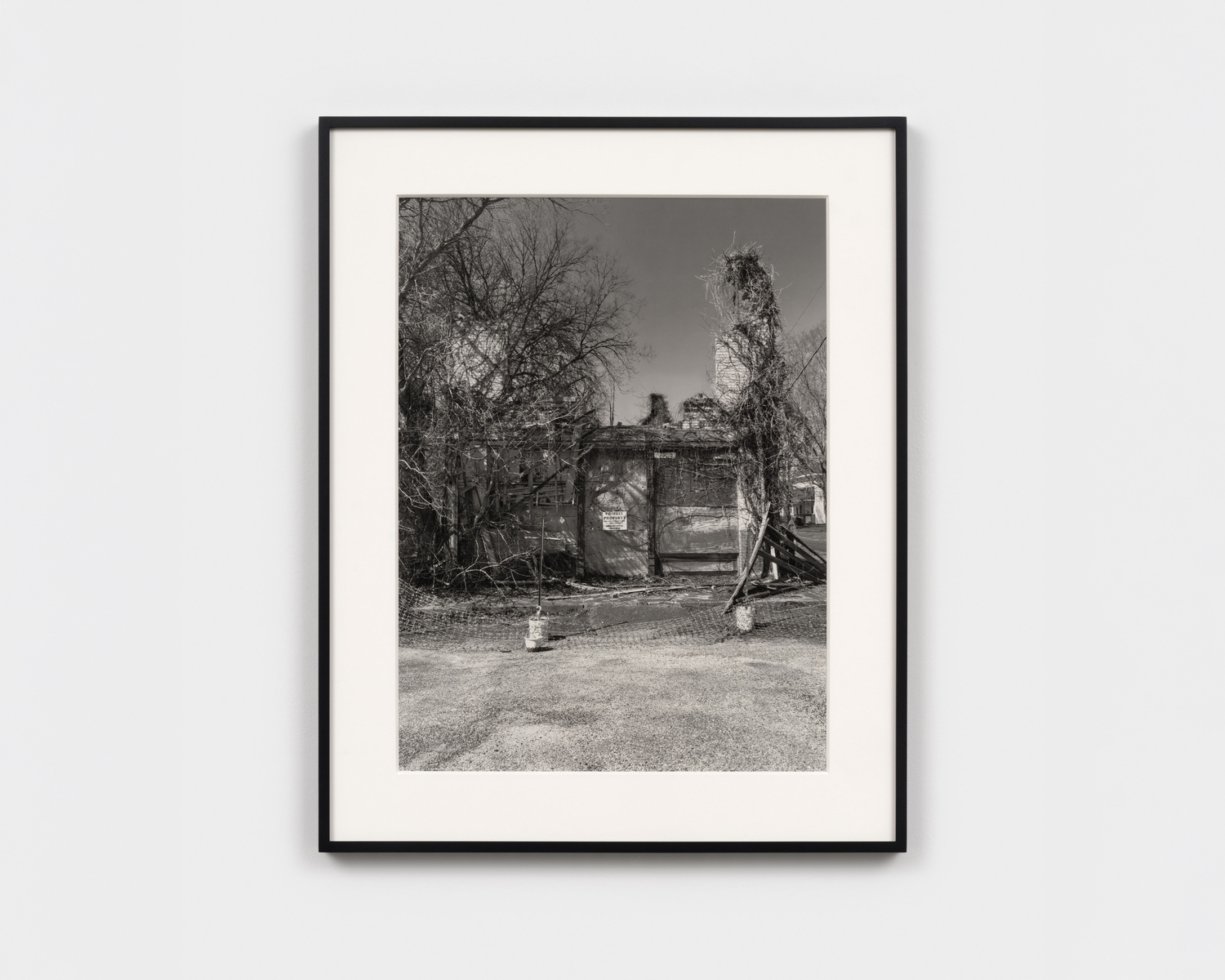
Ralph Lemon, Untitled (Bryant's Grocery and Meat Market, Money, Mississippi), 2018, digital gelatin silver print, 22 x 17 in. (55.9 x 43.2 cm), frame: 25 3/8 x 20 1/4 x 1 3/8 in. (64.5 x 51.4 x 3.5 cm).
In college, a professor introduced me to her version of the Sorites Paradox. The class was debating physician assisted suicide, addressing the question of how policy makers draw boundaries when criteria is based on vague terms, attempting to satisfy the insoluble questions. In this case: how do we define unbearable suffering?
The professor asked us to imagine a sandcastle. Think about removing one grain of sand, she said. The structure is still a sandcastle. If we continue this process, at what point does the sandcastle become a mound? And, in fitting with the traditional definition of the Sorites Paradox (also known as the “Paradox of the Heap”), when does the mound itself cease to exist? There is no natural point, she emphasized, where someone becomes eligible for death.
I was reminded of this paradox, in an entirely distinct context, while walking through Ralph Lemon’s exhibition From Out of Space at Paula Cooper Gallery. This never-before-exhibited body of work opens with a collection of small gelatin silver prints, shot in the early 2000s, depicting varying scenes across the Deep South. The pictures’ parenthetical titles hint at the significance of these otherwise unremarkable landscapes. Untitled (Site of the local jail that held Chaney, Goodman, and Schwerner, Philadelphia, Mississippi) (2002), for instance, shows where three Black men were imprisoned for speeding before, upon release, being stalked and murdered by the Ku Klux Klan in 1964. In Untitled (Edmund Pettus Bridge, Selma, Alabama) (2001), we see the bridge where peaceful Civil Rights protestors, walking from Selma to Montgomery, were brutally attacked on Bloody Sunday in 1965. This bridge is the setting of one of Lemon’s “counter-memorials” from 2001, screened on a monitor sitting on the ground nearby. For nearly eight minutes, the artist steadily marches over the bridge, incrementally dropping and gathering a collection of records he holds, before continuing his march.
Like its counterparts, Untitled (Bryant’s Grocery and Meat Market, Money, Mississippi) (2002) features a space haunted by acts of racial terrorism. It was outside of the now-decaying grocery store that fourteen-year-old Emmett Till was accused of whistling at a white woman, Carolyn Bryant. In the adjacent gallery space, Lemon expands on Till’s narrative. Through now-digital photographs, taken over fifteen years later, we re-encounter the grocery store—noticeably more dilapidated than before. Lemon also captures the barn where Till was brutally tortured and killed, the river where his mutilated body was discarded, and the crumbling funeral home that embalmed his recovered, bloated corpse before sending it home for an open-casket funeral in Chicago.
On the other side of the wall, the centerpiece of the exhibition—a single channel video titled From Out of Space (2018–2021)—activates these landscapes. “This beyond appears to be a before” the looped film announces. From there, we encounter new angles of the aforementioned sites: a surveillance-style drone shot of the overgrown grocery store; a close-up of the rafters of the barn that once bore witness to a brutal murder; a nearly un-identifiable, zoomed-in view of the sediment filled river.
“There is a remote wonderment to most landscapes of ruins,” text interrupts the footage to inform viewers. It concludes: “Where the past patiently decays, visual memory—constituted in the mind’s eye—is allowed to linger.” Lemon captures this wonderment so seamlessly, through his life-less shots of humanity’s harrowing debris, that I found myself unknowingly caught in the loop, unsure if I was experiencing the beyond or the before. Sigmund Freud proposed that by repeatedly recalling the moment of the traumatic encounter, we free it from the unconscious, ascribing it meaning alongside the pain. In front of From Out of Space, inadvertently partaking in this process of traumatic repetition, the pain was, indeed, palpable.
The meaning, however, continued to evolve, especially when I later learned that the grocery store is owned by the descendant of a juror who acquitted Till’s murderers. The owner’s efforts have made the space impossible to sell and, consequentially, difficult to memorialize. In a conversation with Thomas J. Lax, Lemon muses that it “seems [the owner] would rather it quietly disappear, an erasure of sorts.”
But to me, the gradual decay of this grocery store is quite loud. By letting the earth slowly reabsorb the remains of the store, the traumatic histories of this space, and a lack of resolution, remain at the forefront. To tear down the store would be an attempt to obliterate the past; to replace it would be an attempt to write a new story altogether; to conserve it would confine it within the past. This subtle process of decomposition continues to take new forms, albeit slowly, rejecting finality.
If a memorial preserves a memory through a structure, then these active ruins are a counter-memorial. Through Lemon’s inconspicuous documentation, we watch as one grain of sand is removed at a time, unable to identify the turning point between then and now. We are hardly aware that the sandcastle and the earth it is built out of are now one and the same.