
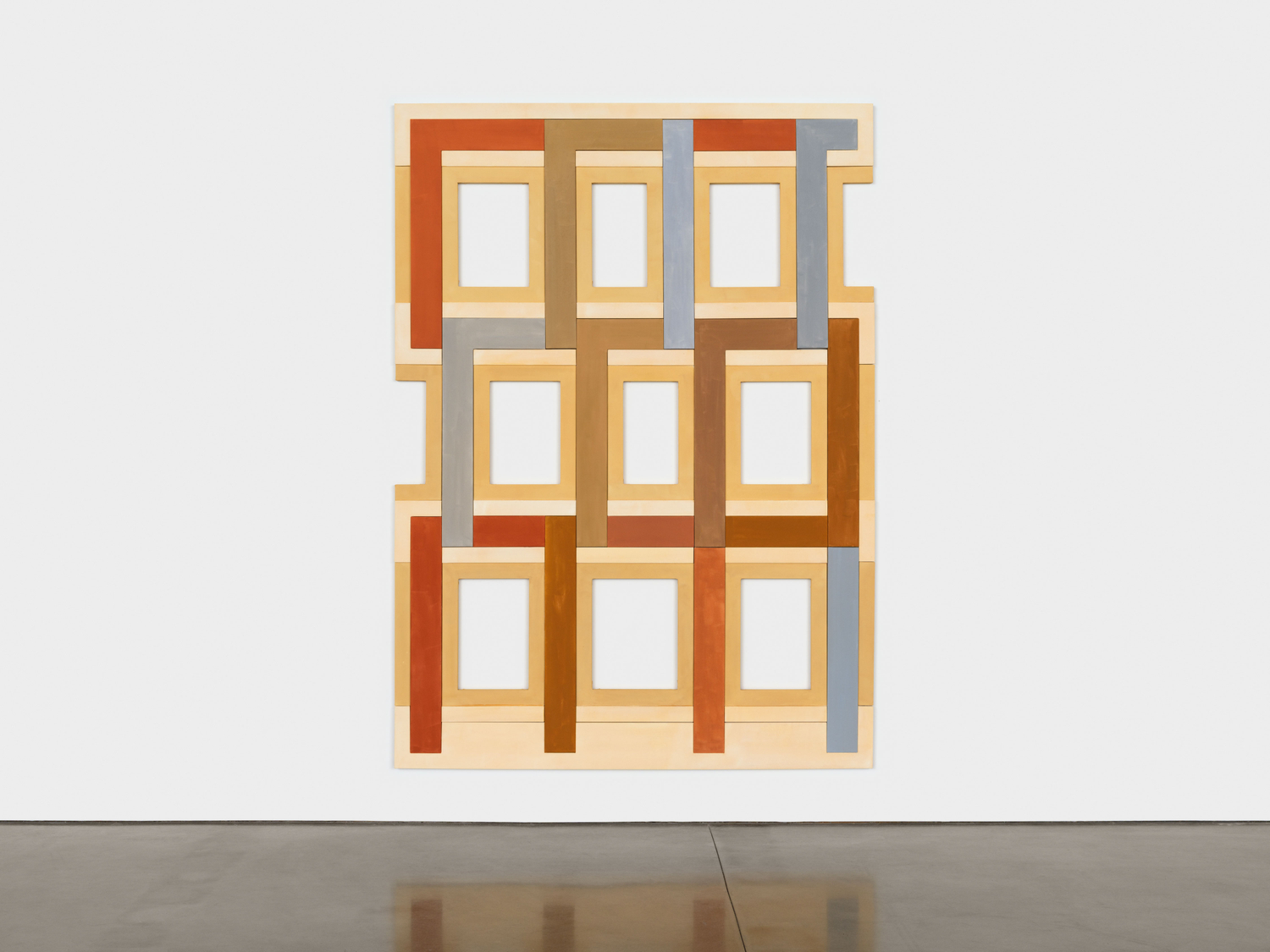
David Novros, Untitled, 2025, oil and murano on canvas, 37 panels, overall: 129 x 93 in. (327.7 x 236.2 cm). © 2026 David Novros / Artists Rights Society (ARS), New York. Courtesy Paula Cooper Gallery, New York. Photo: Steven Probert Studio.
David Novros cunningly creates a kind of 3D fresco. The longtime fresco-inspired minimalist, bred in the company of Donald Judd and in the chapels of Italy, adds depth and a bit of texture to Juddian flatness and precision. He sometimes builds with what seem to be solid blocks of space.
Softening the legacy of Judd, Novros’s wall paintings let in air and light, and jigger geometry so that each time and at whatever angle we gaze at his works, they appear very slightly different. In Paula Cooper’s main gallery area, there are five geometric wall paintings featuring groups that engage us through their unlikely off-beat hues, their subtle asymmetric geometries, and their sense of motion. Novros aptly calls these large canvases “portable murals.”
He makes places and spaces whereas Judd made objects. Novros’s environments are all-embracing. Dramatically hanging alone in the front gallery space, is an untitled oil-on-canvas work consisting of thirty-seven panels and measuring 129 by 93 inches (2025). Painted in shades of orange, yellow, and greenish gray, the work is puzzle-like and marked by superannuated shadows within and outside its structural boxes, adding depth and even a bit of confusion in the viewing. Are the shadows painted on or applied pieces, we are led to wonder, and we see triangular corners within the structures often crushed together; this lends the works a handcrafted attitude just as can be perceived in the densely woven nature of the canvas with slight textural variations. The work actively engages the wall, held by emptiness. Together, the inclusion of that space and the sense of a filmic progression activates the work.
By contrast, we can sense the weight of the canvases’ architecture with the large wall paintings alluding to stone blocks that are built with slight spaces in between them—not sharp lines, but rather imperfect ones lending variation to their geometry. You might refer to them as perfect imperfections.
The show reveals a broad range of art and investigation. There are the heavy, blocky works accompanied by large, as if solid, voids set asymmetrically at one side of a construction, and the puzzle-like structures appear as if they were external architectural bones or jungle gyms. They look like they might support the compositions, holding in place solid voids. On another note, five watercolors in the show tell an almost different story. They are light-infused, luminous, and poetic in Turneresque tones without gestures and filled with stillness. We can detect the atmosphere. From weightiness to delicacy, Novros commands his territory, imbued with some gentle nature and forceful visual introspection.
These works, characteristically for Novros, evoke a sense of the Southwest in their configurations as well as nods to antiquity. As strong and dense as they appear, the loosely built structures convey a feeling of warmth and connection with place.
He said in a November 2023 interview in BOMB magazine that they “reflect my interest in ninth- and tenth-century Asturias painting and architecture. The work that I saw in Oviedo and other places reminded me a great deal of the kind of paintings that were made on the walls of Ravenna, Rome, and Herculaneum.”
Novros is a quintessential late-twentieth-century artist: politically and socially engaged, a dedicated abstractionist, a painter, a sculptor, a poet, and a participant in New York’s bohemian downtown life. Testifying to his connection is the fresco he painted in 1970 in the Spring Street studio of his friend Donald Judd.
Ultimately, the irony is how Novros’s compositions might be considered anti-Judd artworks. They are not objects to possess but environments to live in and gaze at.