
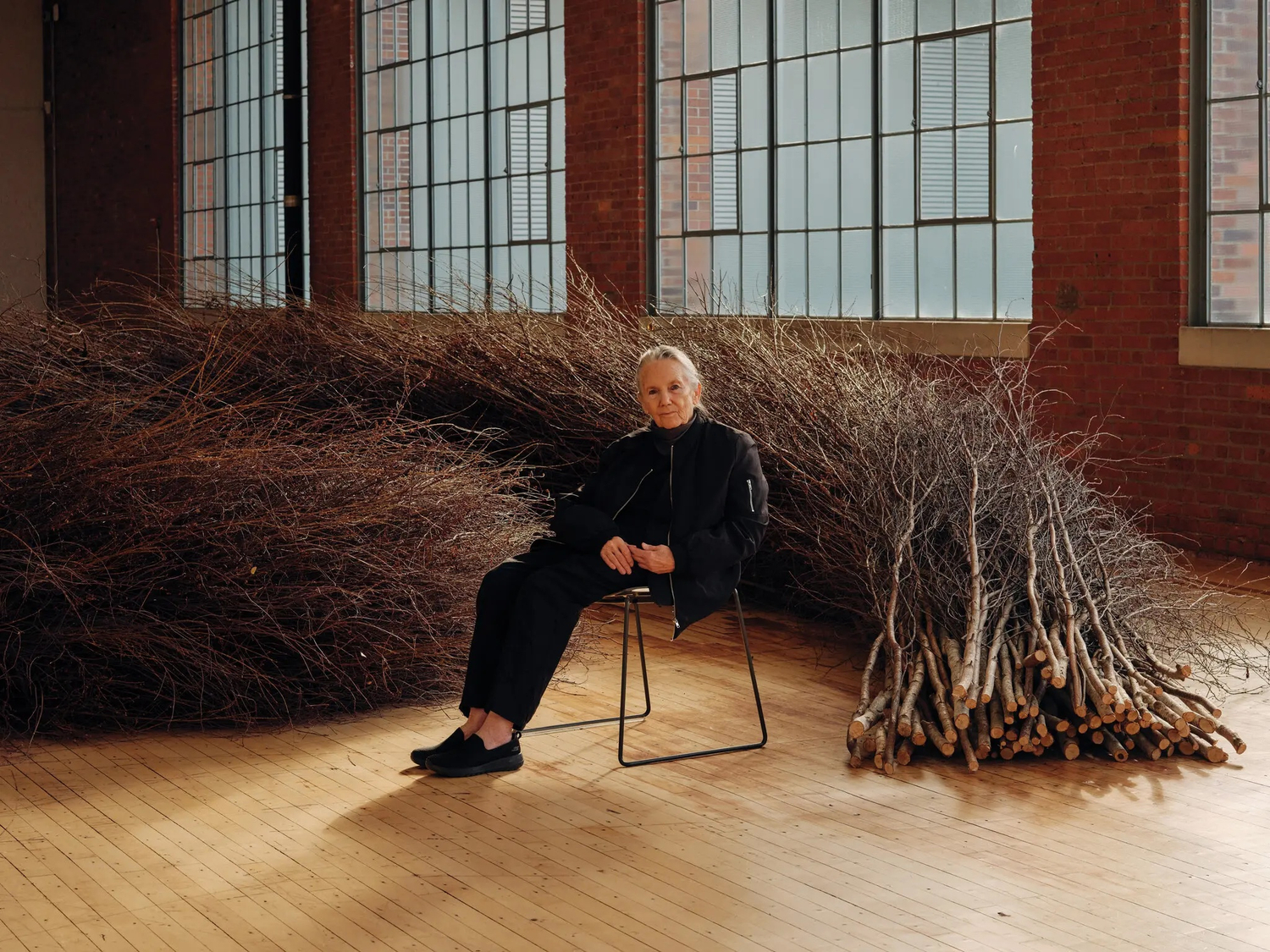
Portrait of Meg Webster with her work “Stick Spiral” (1986) at Dia Beacon, 2026. Photo: Emiliano Granado
Meg Webster revels in impermanence. Here, her story in five works.
I. ‘MOSS BED, KING’ (1986)
Two years ago, Meg Webster installed nine sculptures at the Dia Beacon museum in upstate New York for the most important exhibition of her career so far. For decades, Webster, 81, has packed, poured or otherwise wrangled unruly organic materials — flowering branches, liquid beeswax, loose salt, earth and sand — into large, improbably precise geometric forms. Her art is a study in entropy, prone to cracking, fading and disintegration. “Concave Earth” (1986-90), a 23-ton column of dark gray-brown soil with a sunken top resembling a volcanic caldera, needed repairs to survive the exhibition, which will close this April. (She’ll have a show of new work at Paula Cooper Gallery in New York in May.) Webster approved the restoration but seemed to miss the ragged fissures museum staff had filled. “It’s kind of wonderful to see it change and get awful,” she said. “You should’ve seen it before, when the cracks were even bigger on the inside. It was primordial.”
Unlike many sculptors who spend their careers crafting objects designed to outlast them, Webster has made an uneasy peace with loss. Many of her works exist only when they’re on public display. Constructed in situ, the sculptures that can’t be moved or stored are destroyed and the materials recycled at the end of each show. Although she does make some more stable objects, many of her most significant pieces exist for just a short period of time. Some have been made only once. Others change every time she resurrects them, partly because she uses local materials (the nearest dirt will do), which vary from place to place. In this sense, Webster works more like a performance artist — or a farmer heeding cycles of dormancy and growth — than like a traditional sculptor. She’ll reap a harvest and then let the fields lie fallow.
Although Webster conceived many of her signature works in response to the nuclear threats of the 1980s, they now read as remarks on climate change and as templates for making art in a world overrun with stuff that never biodegrades. Some are subtle inducements to commune with fragile forms of life. Take “Moss Bed, King” (1986), a mound of emerald green moss the size and shape of a king-size mattress, on view at Dia Beacon. It requires regular watering and other forms of care to last.
Webster’s embrace of fleeting materials is one of the reasons she’s so relevant right now, but it’s also why recognition was a long time coming. “Meg’s not had a celebrated career in the way that I think she should have,” said Jessica Morgan, the director of the Dia Art Foundation. “Part of that is probably to do with the fact that these works are ephemeral. Where do you go to see a Meg Webster?” Even after 40-odd years, destroying the works is difficult for the artist. “I’m not happy with them disappearing,” she said as she regarded them at one end of the cavernous gallery. “But I’m not happy with them staying forever, either.”
II. ‘SOFT BROCH’ (1984)
Ask Webster about a sculpture and she’ll tell you where it was first installed and then proceed to run through every other work that was on view then too. This tendency can be maddening until one realizes these webs of association are how Webster keeps her works alive.
Childhood memories aren’t as forthcoming. After she was born in San Francisco, her parents moved to New Hampshire and then to Virginia when she was around 10. She remembers Ollie, Pink and Bocello, the horses she and her younger sister grew up riding competitively, but not being held by her mother. “I don’t think she did much holding,” said Webster. “Did your mother hold you?” she asked Jake Ewert, who travels with her to install shows.
“Sure,” he said.
“She did?” said Webster, incredulous. “I don’t remember being held.”
Webster adored her father, an orthopedist, although she sees him in a different light today. “There was a weakness in his character for sure,” she said. “He was a lovely man. … He was caring. Never raised his voice. But he was a bit of a cad, to say the least.” Webster’s mother died of an overdose of barbiturates and alcohol when the artist was 16.
Many of Webster’s largest pieces form enclosures: places that keep people together or prevent them from drifting apart. In 1984, the year after she earned an M.F.A. from the Yale School of Art, she made an enviable New York debut. The artist Donald Judd, who’d seen her graduate work, invited her to show in the gallery of his home in SoHo. There, Webster built “Soft Broch,” a conical shelter, with sloping 10-foot walls made of hay, that visitors could stand inside. It was designed to make them viscerally aware of the hay — its prickles, its bulk, its barnyard smell — and of the other people sharing the intimate space.
By the time the exhibition opened, Webster had been divorced twice and was living in New York, where she remains today, in TriBeCa. The artist, who’s single and doesn’t have children, doubts she would’ve had much of a career if she’d stayed married. Still, she dwells on the voids. “Loss is an interesting problem,” said Webster while gazing absently at “Stick Spiral” (1986), a gyre of leafless branches circling around an empty center. “I wonder if that has anything to do with the works?” Webster constantly loses her sculptures, but she can always bring them back.
III. ‘HOLLOW’ (1985)
Living plants became part of Webster’s art in 1985, when she created her first outdoor work on the grounds of the Nassau County Museum of Art in Roslyn Harbor, N.Y. She’d been fascinated with plants’ resilience ever since she took an undergraduate ecology course at Old Dominion University in Norfolk, Va. “I started looking at things that grew up in the cracks,” she said.
In Roslyn Harbor, Webster built tall earthen walls around an enormous depression. The structure looked bare from the outside, but visitors who followed a long trench to a narrow entrance discovered a room alive with daffodils, clover, purple pincushions and other flowers. In 1985, Gary Indiana, then an art critic for The Village Voice, wrote that “Hollow” took “the transience of everything, including itself, cheerfully in its stride.” It was the middle of the AIDS crisis, and Indiana found in “Hollow” a place where lives and deaths on the margins regained their meaning.
Webster says she wasn’t consciously responding to the epidemic when she made “Hollow”; she was thinking about scale. Even her largest installations don’t dwarf visitors, the way the monumental projects of some land artists do. She wants her works to feel familiar, as though they’re “not something separate from you” but almost extensions of the body. “Hollow,” Indiana concluded, “makes you feel that living and dying are important processes to pay attention to, and that everyone is always doing both.”
IV. ‘CONCAVE ROOM FOR BEES’ (2016)
After the success of “Hollow,” Webster pursued increasingly ambitious projects. In 1986, she exhibited “Circuit” at Art Galaxy, a now-defunct Manhattan gallery that she filled with tulips, a tank of water, a cone of soil, a table laden with fruits and vegetables and live animals, including a chicken and a rabbit, symbolizing cycles of growth and consumption. In 1992, she constructed a room made of salvaged windows in the lobby of the Brooklyn Museum where visitors could read how-to books on farming and starting sustainable small businesses.
Webster’s environmentalist concerns weren’t always warmly received by the art world. In 2008, the critic Paul O’Brien wrote in Circa Art Magazine that her work was “difficult to distinguish from gardening.” Occasionally, Webster seemed to share these suspicions. Her art isn’t polemical, unlike that of some younger artists addressing the climate crisis, and she sometimes wonders if her sculptures are doing enough. “They’re so beautiful,” she said. “Is that really engaging the times?”
She may well have been asking herself this in 2016, when she created “Concave Room for Bees,” a raised circular garden of flowering plants designed to attract pollinators at Socrates Sculpture Park in Queens, across the East River from Manhattan’s gray skyline. Throughout the summer, bees and butterflies darted between stalks of lavender, goldenrod and blooming black-eyed Susans. After 10 months, the work’s 300 cubic yards of dirt were raked across the park, which needed fertile topsoil: Once a commentary on the ecosystem, the installation had become part of the ecosystem itself.
V. ‘NEAREST FOREST SOIL’ (1987)
It was only at the end of our interview, when the conversation had turned to houseplants, restaurants and other prosaic matters, that Webster mentioned she has stage-four breast cancer. She listed the treatments she’s received so far — a round of radiation, various medications — as if they were minor plot points in a movie of little interest. “It’s all right, I’m gonna make it,” she said. “I’m not dying. I can tell you that.”
Just then, we rounded a corner and found ourselves back in her exhibition: “Hey, look how many people there are!” she said. Two men stood nose to nose with a curving wall of fragrant, butter yellow beeswax, taking deep whiffs. A toddler crouched beside the bed of moss, visibly transfixed by the greens. Before leaving the gallery, Webster paused to linger beside “Nearest Forest Soil,” a girthy, five-ton cylinder of gray earth first made in 1987. It looks like a concrete support one might find on a construction site and is arguably the least charismatic sculpture in the show, the plain cousin to the bristling spiral of branches, dramatic earthen domes and glittering cone of bright white salt elsewhere in the gallery. This sculpture, though, is more personal. It corresponds directly to Webster’s body, measuring as wide as she is tall. It once came up to her waist, although now that she uses a mobility scooter to get around, it’s at about eye level.
“I love this piece,” said Webster. “Its mass and its stability and its feeling of weight.” Solid as it appears, the work is fragile. “They’re gonna have fun chopping it up,” she said. “They have to put it out somewhere where it can be alive again,” she added. “They have to put it in the woods.”